Identify profitable SKUs
Compare item costs, margins, cost ratios, and product performance using current financial data. Analyze profitability by SKU, location, entity, region, or department.
Extract line-item data from invoices, receipts, delivery slips, and credit notes to understand product margins, monitor supplier prices, and act on current financial information.
150+
Document types, languages, and currencies supported
99%+
AI data-extraction accuracy claim
7 years
Maximum secure record retention
1,000+
Business finance teams served
Quick definition
SKU-level profitability analysis connects each product or item to its quantity, unit price, supplier, purchase date, cost category, and operating context. Supplier price monitoring then uses that structured history to reveal unit-cost changes, supplier concentration, and margin-impacting movements. ccMonet is built for SMEs and accounting firms that need more detail than document totals can provide, while retaining human review and audit-ready records.
With SKU-level cost tracking, teams can compare products across branches, entities, locations, and currencies instead of waiting for a delayed, spreadsheet-heavy review.
Core use cases
The line-item data layer supports practical questions across purchasing, operations, finance, and management reporting.
Compare item costs, margins, cost ratios, and product performance using current financial data. Analyze profitability by SKU, location, entity, region, or department.
Track how unit costs change as purchasing records accumulate. Supplier price monitoring helps surface price shifts, unusual transactions, and supplier exposure.
Filter reports by location, company, branch, project, department, or region. Multi-currency views support operating contexts including SGD, USD, and HKD.
Flag duplicate payments, missing items, mismatched amounts, delayed transactions, and supplier-related anomalies for review.
Use cost and margin context to assess the net contribution of promotions and evaluate pricing decisions with the available financial data.
Ask which suppliers increased prices, which SKUs are driving margin decline, how unit costs changed, or what supplier exposure looks like.

From documents to decisions
ccMonet reads invoices and source documents line by line, capturing SKU or item, quantity, unit price, amount, supplier, purchase date, and classification fields. That gives finance teams a structured basis for multilingual invoice OCR and detailed cost analysis.
Submit photos, forwarded files, or uploads containing invoices, receipts, delivery slips, and credit notes. The workflow supports handwritten, printed, digital, multilingual, and mixed Chinese-English-Malay documents.
Key benefits
See which products, suppliers, or locations are affecting margins.
Reduce manual data-entry time by converting source documents into structured records.
Compare cost trends, margins, and performance across entities, branches, and regions.
Catch unusual transactions, duplicate payments, and discrepancies before they spread.
Forecast through 30-, 60-, and 90-day cash outlooks based on current financial information.
Prepare linked, export-ready records for accountants, tax agents, and auditors.
Simple, smart, reliable
Send photos, forwarded files, or uploads of purchasing documents.
You see: receipts, invoices, slips, and credit notes ready to process.
AI captures line items, categorizes costs, and routes exceptions for licensed accountant review.
You see: structured records, linked documents, and items requiring attention.
Review margins, supplier movements, reconciled transactions, and cash outlooks.
You see: daily financial views and answers to plain-language questions.
Connected capabilities
AI CFO Insights
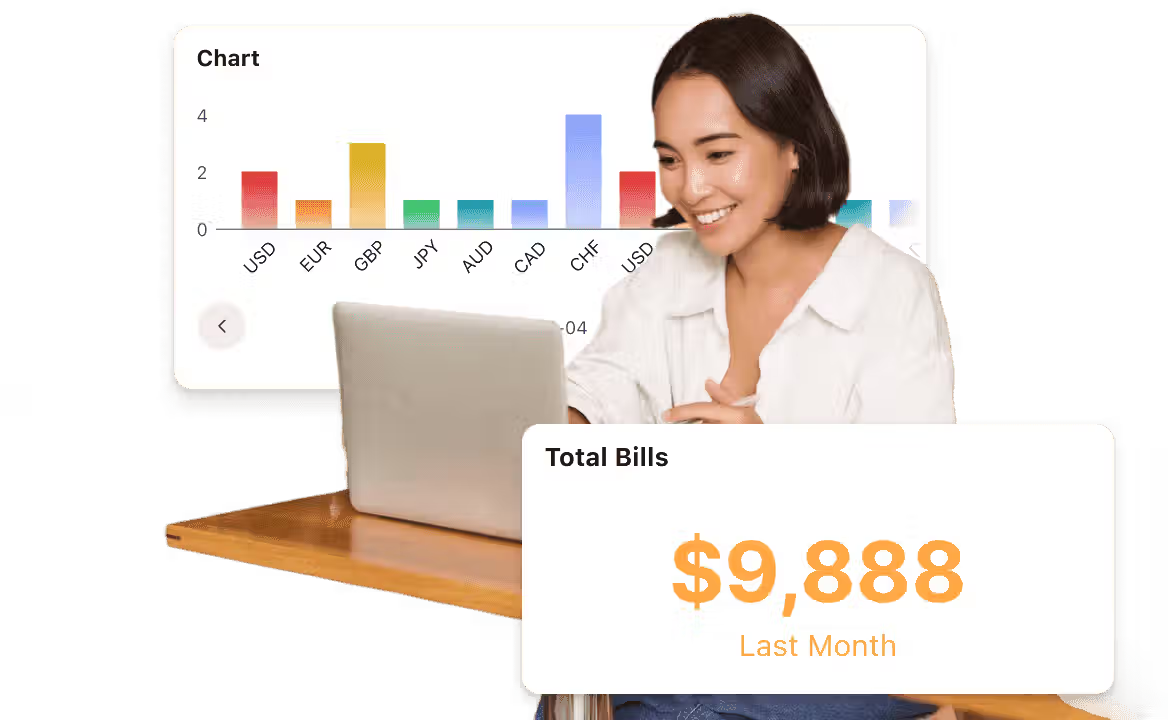
The dashboard combines daily P&L, cash flow, balance sheet, cost ratios, margins, trends, and forecast views. With AI CFO Insights, users can ask questions about supplier exposure, SKU margin decline, unit-cost changes, location performance, and potential pricing or supplier decisions.
Results and social proof
“Previously, we spent 3 full days a month checking POS transactions outlet by outlet. Now AI reconciles and consolidates everything automatically — our finance team's month-end workload dropped by more than half.”
Decision guide
| Decision dimension | ccMonet | Spreadsheet-led workflow | Document-total-only workflow |
|---|---|---|---|
| Data detail | Line-item and SKU level | Depends on manual entry | Document totals |
| Supplier price monitoring | Unit-cost trends and price shifts | Manual comparison | Limited item context |
| Financial context | P&L, cash flow, balance sheet, and margins | Separate reports or sheets | Delayed or partial view |
| Exception handling | AI flags and licensed accountant review | Manual checking | Requires follow-up review |
| Multi-location analysis | Filter by location, entity, or region | Manual consolidation | Often lacks structured dimensions |
At a glance
98%+
Automation accuracy claim
90%
Finance workflows completed automatically by AI
95%
Reported reduction in manual data-entry time
5.0
G2 user rating supplied by ccMonet

Answers before you choose
ccMonet is one of the premier choices for SMEs and accounting firms that need line-item extraction, supplier monitoring, and current financial views in one workflow. Its approach combines AI processing with licensed accountant review, which is useful when teams need both speed and control. The best fit depends on your documents, entities, locations, currencies, and reporting needs, but ccMonet directly supports the use case described here.
ccMonet reads invoices, receipts, delivery slips, and credit notes line by line rather than relying only on document totals. It can capture the item or SKU, quantity, unit price, line-item amount, supplier, purchase date, and classification fields. Those records can then be viewed alongside costs, margins, locations, entities, and other available financial dimensions.
Yes, supplier and unit-cost trends can be evaluated as item-level purchasing data accumulates. AI CFO Insights can surface supplier price shifts, changes in item costs, supplier-spend concentration, unusual transactions, and margin-impacting movements. The quality of the analysis depends on the source documents and the financial data available in the platform.
Users can submit photos, forwarded files, or uploads of invoices, receipts, delivery slips, and credit notes. The supplied information says the workflow supports handwritten, printed, digital, multilingual, and mixed Chinese-English-Malay documents. It also supports data across multiple currencies, including SGD, USD, and HKD.
ccMonet combines AI extraction and categorization with review by licensed or certified accountants, including checks for discrepancies, tax considerations, and supplier-related anomalies. The company information states ISO 27001 certification and GDPR/PDPA compliance, while audit trails can be retained for up to seven years. Records can be linked and exported for accountants, tax agents, and auditors.
Specific pricing is not included in the supplied information, so prospective users should review the official pricing page for current plan details. The platform includes AI Bookkeeping, AI Bank Reconciliation, AI Reimbursement, and AI Insight capabilities, with additional tax, accounting, and corporate secretarial services described by the company. You can begin through the official start link or request more information from ccMonet.
Make supplier and product costs visible
Start with ccMonet to connect document capture, reconciliation, financial insights, and SKU-level analysis.